
CONSUMER INFORMATION on PHOTOCATALYSIS and ISO 22197 VALIDATION



Why are we explaining all this?
Photocatalysis is a technology with a solid scientific foundation, yet it remains relatively unknown outside specific technical environments. In emerging markets, rigorously tested solutions coexist with others that use the same terminology without the same level of validation.
For this reason, we believe it is necessary to clearly explain what it is, how its effectiveness is measured, and what the published data truly mean. This is not about impressing with technical jargon, but about enabling understanding and objective comparison.
What is photocatalysis?
Photocatalysis is a chemical process activated by UV-A light. When this light strikes titanium dioxide (TiO₂), the material generates reactive species capable of transforming pollutants into simpler and more stable substances, mainly carbon dioxide (CO₂) and water (H₂O).
.webp)
.webp)
.webp)
.webp)
.webp)
Do all photocatalytic products work the same way?
No.
The term “photocatalytic” describes a chemical principle, but it does not by itself guarantee a specific level of performance.
Actual effectiveness depends on several factors:
- The quality and nature of the titanium dioxide used.
- How it is fixed to the substrate.
- The available active surface area.
- The stability of the coating.
- The intensity and distribution of UV light.
- The design of the system in which it is integrated.
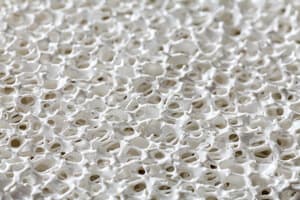
For example, a conventional ceramic foam is not photocatalytic by default. It will only be so if it incorporates a specific active coating and the complete system has been validated through testing.
At first glance, two materials may appear identical. The difference can only be demonstrated through measurable data.
How has it been tested and what exactly do the data mean?
In order to compare results objectively, standardized methods exist. In the field of air purification, ISO 22197 establishes procedures to evaluate photocatalytic activity under controlled conditions.
In our case, it is important to clearly differentiate two levels of testing.

Tests performed and traceability
Test on the complete ceramic foam (ISO 22197 – NOx)
NOx reduction: 96%
Laboratory: EPTISA
C/ Pirita 33 – Pol. San Cristóbal – 47012 Valladolid
LECCE Registry No. CYL-L-005
Work: PR24QCVAL0000-267
Sample: VLF.190419 – Code: 11-833590
Tests performed on the photocatalytic coating
Toluene reduction: 35.7%
Laboratory: University of Chemical Technology, Prague
Document: No. VSCHT 17-12-15
It is important to differentiate that these latter data correspond to the active material (coating), whereas the NOx test was performed on the complete ceramic foam.
Continuous improvement and expanded validation
In order to further strengthen validation of the complete system, an additional test is planned in accordance with ISO 22197-1, ISO 22197-2 or ISO 22197-3 directly on the ceramic substrate, focused on a volatile organic compound (VOC).
This will provide a standardized VOC reference tested on the complete ceramic support, complementing current data and expanding the system’s documentation base.
How to interpret the results
The standard tests specific pollutants, but the photocatalytic mechanism is not designed to act on a single specific substance. When the material is activated, it reacts with many organic molecules capable of oxidation.
Therefore, the tests serve as an objective reference of oxidative capacity under controlled conditions. They are not commercial promises, but verifiable technical measurements.
Consistency and transparency
Our way of working is based on a simple idea: if a technology is good, it does not need exaggeration. It needs data, context and explanation.
We want anyone considering this solution to do so with clear information, distinguishing what has been tested from what is in progress, and understanding what each figure represents.
It is a matter of professional consistency and respect for those who place their trust in us.
Our commitment
We understand photocatalysis as a technology with a real scientific foundation and demonstrable effectiveness when properly designed and implemented. We do not present it as a miracle solution or as a universal substitute for other systems.
Our commitment is to continue working with verifiable testing, continuous improvement and responsible communication.
If someone decides to invest in this technology, we want them to do so with knowledge and confidence. And if they compare options, they should be able to do so with clear, documented and verifiable information.